by Stephen Olsen – originally published August 27, 2025
Given almost every imaginable issue that councils handle relates directly to urban design and urban development, it was fitting that one of the first chances to put Mayoral candidates through their paces has been jointly organised by the Urban Design Forum (UDF Aotearoa) and Urban Development Institute (UDINZ).
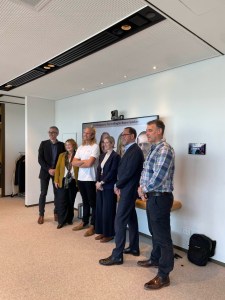
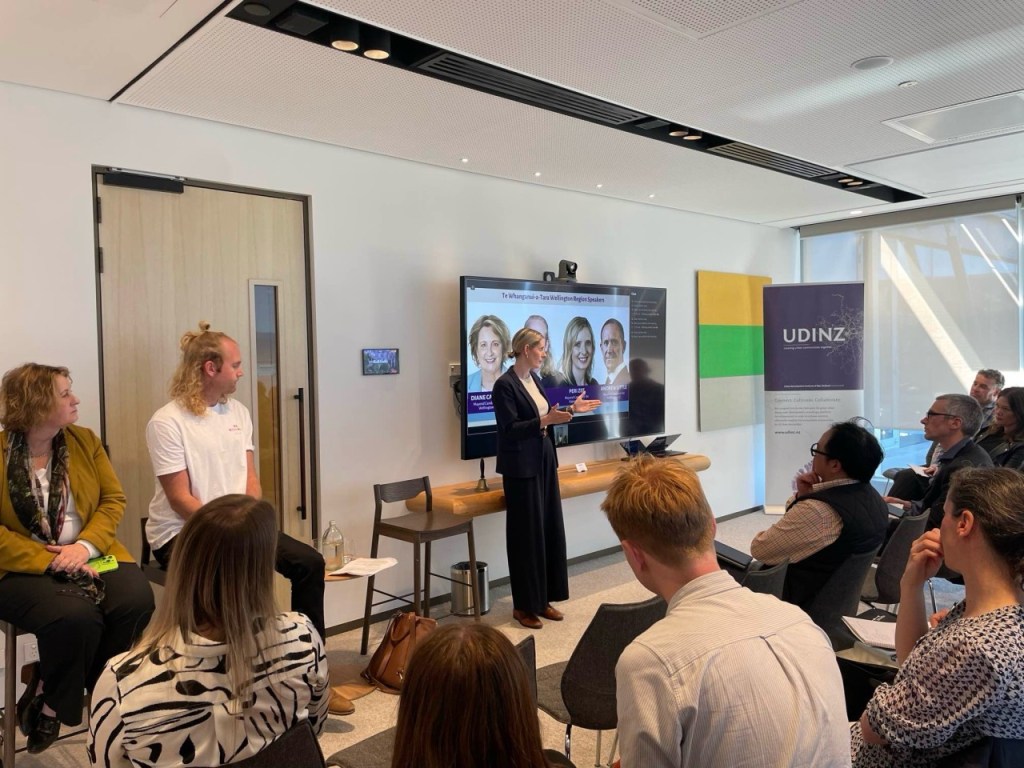
For Wellington this saw mayoral candidates Diane Calvert, Alex Baker and Andrew Little, as well as Upper Hutt candidate Peri Zee, present their views to an audience of about 30 people on Tuesday in what might be considered a ‘warm up’ discussion.
Introductions were made by James Solari (UDINZ), Jos Coolen (UDF Aotearoa) and urban regeneration specialist Anna Harley of Place Collective, followed by a structured set of questions asked by the hosts. Ray Chung attended as an audience member, but was heard from only when his phone rang out to the tone of dogs barking.
A notable aspect of the lineup was the respective professional backgrounds of Peri Zee and Alex Baker in urban planning and sustainability strategy. This came to the fore, and it was also a genuine bonus to have Peri’s voice from outside the realm of the WCC.
Peri’s first point was that Upper Hutt is demonstrating greater growth than Wellington city, yet is left out of conversations. One focus of her thinking is the place of public transport as a “critical life line” for Upper Hutt and a need for more railway stations for the upper north of the city. As featured on The Spinoff in April, she is an excellent champion for Upper Hutt and local government sector.
Alex’s point of reference turned out to be comparisons between Wellington and Hamilton, with Hamilton outshining Wellington on many counts.
“We need to be better at attracting investment and controlling costs,” said Alex, adding that turning to austerity or populist mandates is not an answer and that relying on central Government isn’t either.
Diane Calvert’s view is that Wellington has suffered from dysfunctional leadership rather than a dysfunctional council. She deplored the erosion of in-house capacity at the WCC accompanied by the pouring of resources into a repetitive sinkhole of plan after plan, and planning of plans.
Andrew Little expressed a desire to leverage off good aspects of the council’s work through applying a stronger focus on finding ways to speed up decisions and actions, with a view towards setting up an Urban Development Office that could be modelled on lessons from Auckland’s Eke Panuku – now part of the unified Auckland Urban Development Office.
This would help enable plans for Wellington to be integrated across its built environment, he suggested, to the eventual benefit of citizens throughout all stages of their lives.
All of the candidates lent weight to arguments for infrastructure priorities and pressures that impact local councils to be equalised across the country.
Peri Zee argued that this should be in the form of concerted packages of financial stimulus, as recently highlighted by a Treasury fiscal tools report, while Alex Baker voiced a concern that Wellington is not getting more value out of utilising its strong asset base, and drew a bold line under the need for ensuring steps to institute rigorous development feasibility and for revenue capture from things like the uplift value of land are taken.
Alex is unimpressed by the city’s lack of commercial finance nous and said there is a need to get much better at articulating and negotiating co-investment opportunities in the city.
Diane Calvert characterised the phase the city is in as one of ripping things up and “[re-]building monuments” (the Town Hall, the Library etc) and stated that in a situation of increased un-affordability for city residents, the time has come to “cut our cloth to fund the things we can”.
Andrew Little favoured an emphasis on improving project management capability, to the extent of having an external reference group of experts to provide independent oversight of projects. He is keen to see a better ability around off-ramps for closer management of exit points for projects when unexpected things like escalating cost over-runs occur. A consistent criteria would be to ask: Is this project lifting the overall state of the city, or not?
The possibility of council amalgamations received an airing – with a general, though cautious, openness to seeking out models that are grounded on better meeting future challenges and are arrived at democratically.
If successful in her Mayoral bid, Peri Zee’s aspiration is to be known for turning around the dynamic of the relationship between the council and community to the point that the community is not seen as an inconvenience.
Similarly Diane Calvert would be aspiring to rebuild community trust and confidence in council leadership, as well as positioning Wellington as ‘open for business’ and as a city where there are choices for everyone about where to live. Three specific hot buttons would be resolve the future of Johnsonville Mall and Khandallah Pool and to advance the readiness of Adelaide Road for intensive development.
Alex Baker harked back to the need to “catch up to Hamilton” as a measure of success, as well as giving more clinical attention to development feasibility and to achieving completion of a safe Golden Mile, while Andrew Little closed out with a motivating wish to get more people into the centre of the city and to improve the reputation of the council.
UDINZ and UDF Aotearoa will be staging similar events next in Christchurch (Thursday this week) and Auckland (on Friday) and will provide summaries of how ‘urbanist’ candidates truly are.
It will be interesting to see how the performance of Wellington sits alongside the other cities – set against its opting out of city deal-making and being caught short on funding for big ticket support from central Government over a long period to the level of hundreds of millions of dollars.
This sad state was highlighted through comments made by Alex Baker on measurable expenditure and on the ungainly public/social housing bind that Wellington finds itself in, and by Diane Calvert’s mention of our slip-prone city becoming seen through a narrowing ‘transport project’ lens by the Beehive.
All in all, the format for this small, admittedly select gathering – hosted at the waterfront offices of Bell Gully – felt fit for purpose. It provided clear air for some necessary big picture thinking, and was a big step up from the quality of election openers three years ago.
One can only hope that this continues into the upcoming ‘town hall’ events between now and the final voting day of 11 October.
Stephen Olsen has given permission for this article to be re-published on The Upper Hutt Connection.
A “thank you” to Peri Zee for requesting that this article be put up on The Upper Hutt Connection.
01/09/25
 The Upper Hutt Connection