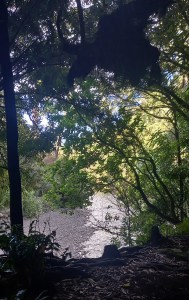
Ko au te awa ko te awa ko au / I am the river the river is me.
In a nutshell. The Council was given one year to decide whether we controlled our own water or joined forces with other Councils. That decision was required by the Department of Internal Affairs by the 3rd of September 2025 with much of the information missing.
That’s like signing a bank agreement for a loan without knowing what the interest rate will be or the terms of the loan. If Council buried their head in the sand and did nothing the Commissioner would make the decision for us.
On the 20th of August Local Water Done Well was passed at an Ordinary Council meeting. The minutes note that as a city we ‘still have a stake through shareholding in the new company” (https://www.upperhutt.govt.nz/files/assets/public/v/2/meetings/2025/cycle-5/council-minutes-20-august-2025.pdf) and the new entity called Metro Water will be live on the 1st of July 2026.
In the meantime we are still responsible for existing water related costs such as Pinehaven (currently on hold due to escalation of cost as decided in a GWRC meeting https://www.upperhutt.govt.nz/files/assets/public/v/1/infrastructure-projects/pinehaven-culverts/pinehaven-floodplain-management-plan-fmp-partial-review.pdf?) dated 25 May 2025. Thank you to Cr Ultra for sharing.
Throughout this process there have been many concerns from community and rightly so. Such as:
Water meters and the effects this will have on us financially and water availability,
Cost of Living Crisis,
The Fabians did some extensive research and asked questions relating to data provided to the community in the latest Annual Plan consultation booklet. Their findings suggest that we will be charged $7 per day. Getting anyone to provide differing information has proved futile. https://www.nzempowered.com/post/local-water-done-well.
No one knows what the new entity will cost us. Ideally, whatever we currently pay should just be charged by a different name with no increase. If anything, a decrease because we are sharing resources and costs.
There has been no mention of environmental sustainability. Growth of 30% is mentioned often. The Pipe Bridge in Kaitoke has capacity transport up to 140,000,000 (million) litres of water from Pakuratahi River PER DAY to supply half the regions daily water needs (just one of four water sources in the area). Yet the treatment plant can only process 80 million litres of water per day. How will 30% growth affect the take from our water and the environmental effect this will have on te taiao. Everything has a cause and effect. The suggestion is another storage lake. Is that compounding the issue. Many have asked why are we flushing our toilets with treated water when it could be harvested water for example.
I have concerns that we are becoming co-dependent rather than truly resilient. Imagine if something were to go wrong. We are completely reliant on infrastructure. Most of us can live for years without power, albeit uncomfortably perhaps. However, we cannot live more than 3-5 days without water.
At the meeting on the 20th of August, I asked why Silverstream Forest was included in the document as a future project when their neighbour Blue Mountains are fully self-sufficient for water. If it suggests that infrastructure is going to be hauled up a hill then who will be paying that cost? The ratepayer under Metro Water?
Weaving the Harakeke held a special meeting on the 21st of July 2025 to discuss water with our Chief Executive Geoff Swainson. We had the opportunity to share our concerns in person kanohi ki te kanohi and Geoff answered each and every one of us with the knowledge available. The questions and answers can be found here. https://www.nzempowered.com/post/weaving-the-harakeke-wai-worry-hui-minutes-21st-july-2025,
Let’s not forget that we are water. Wairua means two waters.
Someone mentioned at a recent hui that the water you drink in England has been through the human body and reprocessed at least 9 times. That’s the known figure. The truth is we are 60-80% water which enters and exists our body and becomes part of the water cycle. So you are recycled water thousands of times over.
What Can we Do?
I’ve heard it said often that “there is nothing we can do!”. THERE IS ALWAYS SOMETHING THAT WE CAN DO.
We can ask the bank manager for more information before signing any documents. (metaphorically) or include‘subject to’ clauses.
What were the effects of water meters being installed in other communities?
Find out if Government subsidies could be created and/or change building codes to create more resilient homes and communities?
This election we can vote for a team who will work together and more importantly SPEAK UP and SPEAK OUT on your behalf.
Water is not a thing or a resource. It lives and moves and sustains life.
How did the essentials of life become so unaffordable?
Authorized by Heather Blissett of Upper Hutt.
A “thank you” to Heather Blissett for sending this article to The Upper Hutt Connection.
08/09/25
 The Upper Hutt Connection