Every year, Bird of the Year captures the imagination of New Zealanders. We champion our favourites, debate their merits, and celebrate the remarkable wildlife that makes Aotearoa unique.
But among all the birds that have captured the public’s attention, few can match the extraordinary story of the karure, the Chatham Island black robin.
It’s a story of hope when there seemed to be none. A story of innovation when conventional solutions had failed. A story of one tiny bird who carried the future of her entire species on her wings.
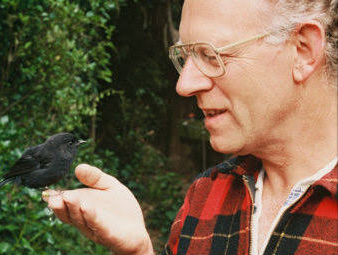
And it is a story with a special connection to Upper Hutt. At the heart of the story was conservation pioneer Don Merton, the man who would become known around the world as the conservationist who saved the black robin from extinction and whose work would become recognised as one of the greatest endangered species recoveries ever achieved. He spent many years living in Upper Hutt, but his journey began as a bird-obsessed youngster nicknamed “bird brain” by his schoolmates. From an early age, he watched birds, searched for nests and learned how to care for wildlife. As a boy, he once placed orphaned goldfinch eggs under his grandmother’s canary, which successfully raised the chicks as its own. It was a simple childhood experiment, but decades later that memory would inspire a groundbreaking conservation technique that would help save a species.
Down to Five Birds: Today, several hundred karure live on the Chatham Islands. Their future appears secure. But in 1980, extinction seemed almost inevitable. Only five black robins remained anywhere on Earth. Of those five birds, just one breeding pair remained. More critically, only one female was still capable of producing fertile eggs.
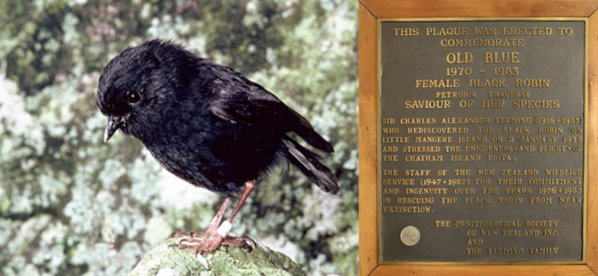
Her name was Old Blue. The last productive female of her species.
Its difficult to imagine a more fragile situation. Every living member of a species had been reduced to a handful of birds surviving on tiny Little Mangere Island, a rugged 15-hectare rocky outcrop in the Chatham Islands, smaller than many Upper Hutt farms. Perched on windswept cliffs and battered by Southern Ocean storms and surrounded by steep drops to the sea, it was an unforgiving place and an unlikely final refuge for a species on the edge of extinction. There was nowhere else left for the karure to go.
On that isolated island, a single female bird named Old Blue and her mate Old Yellow carried the hopes of an entire species.
One storm. One accident. One failed breeding season. That was all it could have taken. Millions of years of evolutionary history rested on the survival of two tiny birds clinging to life at the edge of the world.
When Don Merton first visited the Chatham Islands in 1968, around 30 black robins remained on Little Mangere Island. By the time he returned with colleagues several years later, the population had fallen further. The decline continued despite the island being free of introduced predators. The karure were simply running out of numbers, genetic diversity and opportunities to recover on their own. Urgent intervention was needed.
Don Merton and his colleagues understood that simply protecting the remaining birds would not save them. The karure needed something more than protection. It needed a second chance.
A Radical Idea: When Don Merton and his team arrived in the Chatham Islands, they understood that merely protecting the remaining birds would not save them. The population was already too small and declining. Traditional conservation approaches had run out of options. The team needed something bold. Something nobody had attempted before with a species this close to extinction.
For Don, the answer came from a lesson learned decades earlier. He remembered how one bird species could successfully raise the young of another. What had begun as a childhood fascination would become one of the most innovative conservation interventions ever attempted.
The solution was called cross-fostering. Whenever Old Blue laid eggs, the eggs were carefully transferred into the nests of another species, the Chatham Island tomtit, which would raise the chicks as their own. Because her eggs had been removed, Old Blue would lay another clutch. Then another. And another.
In normal circumstances, a robin might raise a single family of chicks each season. Through this innovative approach, Old Blue could produce many more offspring than nature alone would allow. It sounds straightforward today. At the time it was anything but.
Nobody knew whether the foster parents would accept the eggs. Nobody knew whether the chicks would survive. Nobody knew whether the robins themselves would continue breeding under these highly unusual circumstances. The risk was enormous. But the risk of doing nothing was extinction.
The Species That Nearly Slipped Away: There were moments when the recovery programme hung by a thread. Every egg mattered. Every chick mattered. Every adult bird mattered.
Unlike most conservation projects, where a lost nest might be a setback, the loss of a nest in a population of five birds could have ended the story completely.
For several years, the future of the karure rested almost entirely on Old Blue and her mate, Old Yellow. They became the last line of defence against extinction.
The programme was not without mistakes either. At one stage conservation staff noticed some eggs being laid on the edge of nests and, trying to help, carefully moved them back into place. Over time the behaviour became more common. The team eventually realised that their intervention was unintentionally favouring birds that laid eggs outside the nest. The practice was stopped, and the population gradually returned to normal nesting behaviour. The episode remains one of the best-known examples of both the power and potential risks of intensive species management
Yet despite the setbacks and uncertainties, Old Blue continued laying eggs. Old Yellow kept breeding. The foster parents raised chicks. And the chicks survived. Slowly, painstakingly, what had seemed impossible started becoming possible. A species once measured in single digits started climbing back from the brink.
The Mother of an Entire Species: Old Blue became famous as the last productive female black robin, but Old Yellow was every bit as important.
Without Old Blue there would have been no future for the species. Without Old Yellow there would have been no future either. Together they became the founders of a future generation. Today every living karure can trace its ancestry back to this remarkable pair.
Old Blue lived for around 13 years, having been born around 1970. She died in 1983 or 1984, but by then the future of the species no longer rested entirely on her shoulders. Her descendants were breeding successfully and the recovery programme was working.
Her influence, however, never ended. Every karure alive today carries a little of Old Blue and Old Yellow within it. Generations have come and gone, but their legacy continues in every black robin that flicks through the forests of the Chatham Islands. A plaque on the Chatham Islands commemorates Old Blue’s contribution. Few animals ever receive such an honour. Fewer still can claim to have saved an entire species.
A Legacy Beyond the Chathams: The success of the black robin recovery transformed conservation thinking, both in New Zealand and internationally. The techniques pioneered by Don Merton and his colleagues showed that extinction was not always inevitable. Creative thinking, careful science, and the courage to try new approaches could sometimes rescue species that appeared beyond saving. The lessons learned from the karure would later influence recovery programmes for other threatened birds, including the iconic kākāpō.
For Upper Hutt, there is also a local lesson in this story. Great conservation achievements are rarely the result of a single grand action. More often they come from persistence. From people who care. From communities willing to act. A trap checked in a reserve. A stream planted with native species. A predator-free backyard. A volunteer giving up part of their weekend to help nature recover. These small actions accumulate into something much larger.
They create hope.
More Than a Bird: As we celebrate Bird of the Year, it’s worth remembering that the karure is more than just another bird species.
It’s proof that hope can prevail when circumstances seem hopeless.
It’s proof that innovation can succeed where conventional thinking fails.
And it’s proof that one determined conservationist from Upper Hutt and one tiny black bird could together achieve what many believed was impossible.
Don Merton died at his home in Tauranga on 10 April 2011, aged 72. I was honoured to speak at his funeral on behalf of Forest & Bird and grateful New Zealanders. Don’s legacy lives on in every karure that survives today. Every black robin that darts through Chatham Island forests owes something to the ideas he pioneered and the courage he showed when others might have accepted defeat.
Old Blue never knew she was saving a species.
Old Yellow never knew he was helping write conservation history.
And Don Merton could never have known that the bold decisions made on a remote, windswept island would become one of the greatest conservation success stories on Earth.
Yet because they refused to let extinction be the final chapter, the song of the karure can still be heard today. For a species that once dwindled to just five birds, that song is nothing short of miraculous.
That may be the most powerful conservation story New Zealand has ever produced.
Barry Wards
Chair, Upper Hutt Forest & Bird
A “thank you” to Barry Wards for sending this article to The Upper Hutt Connection.
29/09/26

