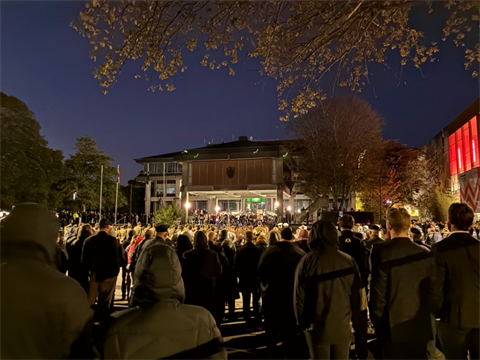
Upper Hutt marked Anzac Day this year with a notable shift in focus as the city formally recognised all New Zealanders who have served in times of war, both overseas and at home, following recent legislative change.
At the Anzac Dawn Service in the city centre, community members gathered to reflect not only on the sacrifices of those who served in earlier conflicts, but also on more recent generations of service personnel.
The expanded scope of remembrance follows the passing of the Anzac Day Amendment Act in February, a change acknowledged during the civic service.
Wing Commander Mark Brewer told attendees the moment marked an important change in how the nation honours service.
“Thanks to the Anzac Day Amendment Act, this year marks the first time we also officially commemorate all who have served New Zealand in times of war, at home and abroad, including those who did not return,” he said.
He situated that shift within Upper Hutt’s long-standing connection to New Zealand’s military history, noting the city’s role since the First World War.
“We acknowledge this city’s strong historic links to New Zealand’s military since 1914,” he said. “It is humbling to think that nearly all of those Kiwis lost in the First World War underwent training at Trentham Camp before departing these shores for battle.”
That legacy, he suggested, continues to shape the way Upper Hutt approaches remembrance today, both in tradition and in its willingness to adapt.
“Upper Hutt has continued to lead the way and maintained its unbroken tradition, established in 1914, of actively supporting our military and the veterans in our community,” he said.
He also recognised the city’s role in acknowledging more recent conflicts, including East Timor and Afghanistan, noting it was among the first in the country to formally commemorate those who served and lost their lives in those operations.
Upper Hutt RSA President Mick Pendlebury said the day reflected a community that understands remembrance as both history and responsibility.
“Anzac Day in Upper Hutt continues to be deeply felt,” he said. “We’re seeing generations come together, not just to remember those who served in the past, but to recognise those who have served more recently.”
Across the day’s services, from the early morning gathering to later civic commemorations, there was a quiet consistency: remembrance here is not static.
In Upper Hutt, it is shaped as much by continuity as it is by change, grounded in a century-old connection to service, while steadily widening to include those whose contributions are only now being formally recognised.
Source: Upper Hutt City Council
29/04/26

