
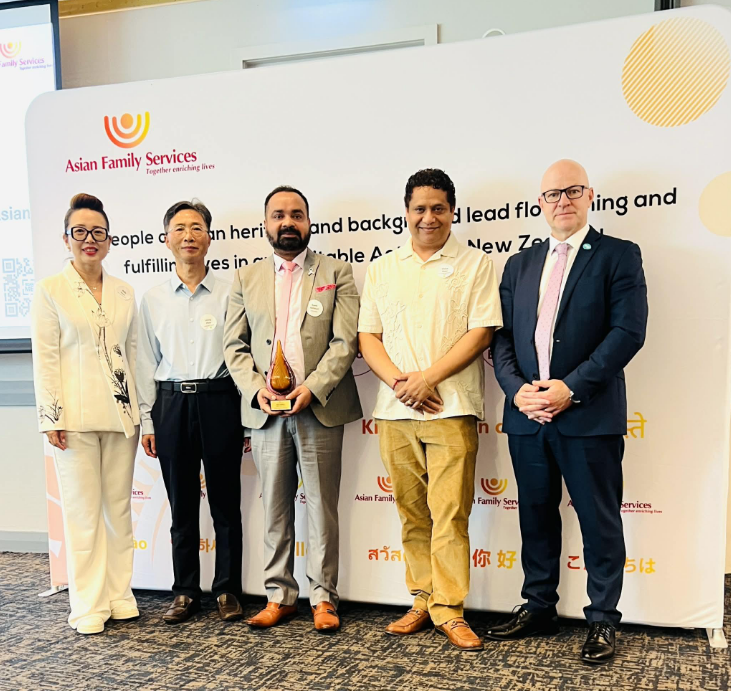
The award, presented by government officials, recognized Dr. Ramil Adhikari’s contributions to public health outreach across New Zealand’s Asian and refugee communities.
AUCKLAND — Dr Ramil Adhikari from Upper Hutt has been recognized for his work supporting migrant, refugee, and ethnic communities across Aotearoa New Zealand, receiving a national honor at a symposium convened to address the health needs of the country’s rapidly growing Asian population.
Dr. Ramil Adhikari was presented with the Public Health Award at the Flourishing Asian Communities & Workforce Symposium on March 13, held in Auckland and organized by Asian Family Services, a national organization that provides counselling, crisis support, and community development resources to Asian, migrant, and refugee populations.
The award was presented by Matt Doocey, the government’s Minister for Mental Health, and Kelly Feng, reflecting an alignment between official health policy and grassroots community advocacy that organizers say is increasingly necessary as New Zealand’s demographic makeup shifts.
In remarks following the presentation, Dr. Adhikari turned to a Māori proverb to frame his response — a choice that spoke to the bicultural and multicultural values running through his work.
“Ehara taku toa i te toa takitahi, engari he toa takitini,” he said. The whakataukī, translated as “My strength is not that of an individual, but that of many,” became the organizing principle of his acceptance.
“This award reflects the collective mahi of many dedicated people working for the wellbeing of Asian, ethnic, migrant, and refugee communities in Aotearoa,” Dr. Adhikari said. He was careful to distribute the credit broadly — to colleagues, community partners, and what he described simply as “our whānau.”
His work, which spans community health outreach, cultural engagement, and efforts to improve access to health services for migrant populations, sits at a crossroads that public health advocates say is often underfunded and overlooked. New Zealand’s Asian-identified population has grown significantly in recent decades, yet research consistently points to gaps in culturally responsive care, language accessibility, and mental health support.
The symposium, which convenes health professionals, community leaders, and policy advocates, is designed in part to close those gaps — bringing together practitioners who operate across institutional and community lines.
For Dr. Adhikari, the recognition was welcome but secondary to the broader message he hoped it would send.
“This recognition belongs to all of us,” he said. “No one achieves this work alone.”
The Flourishing Asian Communities & Workforce Symposium is an annual gathering organized by Asian Family Services, based in Auckland.
By Soren Neupane: content creator, tutor
A “thank you” to Soren Neupane for sending this article to The Upper Hutt Connection.
23/03/26
 The Upper Hutt Connection