
Tiaki Wai Board Chair Will Peet says the Wellington region’s new water organisation is looking forward to getting on with the job of delivering resilient water services for the region while keeping costs as low as possible.
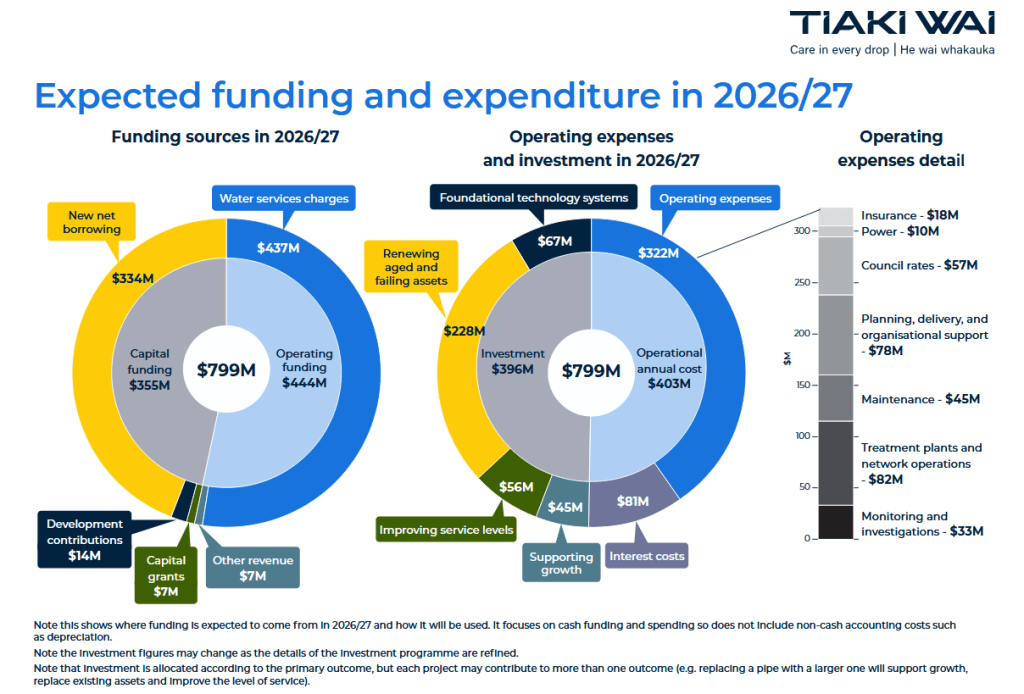
“This coming year our communities will see Tiaki Wai spending around $800 million. About half will go into replacing and upgrading aging pipes and other critical assets, and foundational technology systems. The rest goes to delivering services across the region; that is keeping water coming out of the taps and safely manging wastewater and stormwater,” says Mr Peet.
From 1 July, the way water services are funded will change, as Tiaki Wai takes over assets and debt from Wellington, Hutt City, Upper Hutt City, Porirua City and Greater Wellington Regional Councils, and property owners start paying directly for water services rather than through rates.
“Our work will be funded through a combination of water services charges (approximately 55 percent), borrowing to spread capital expenditure costs over time, and other fees and charges including growth-related charges,” says Mr Peet.
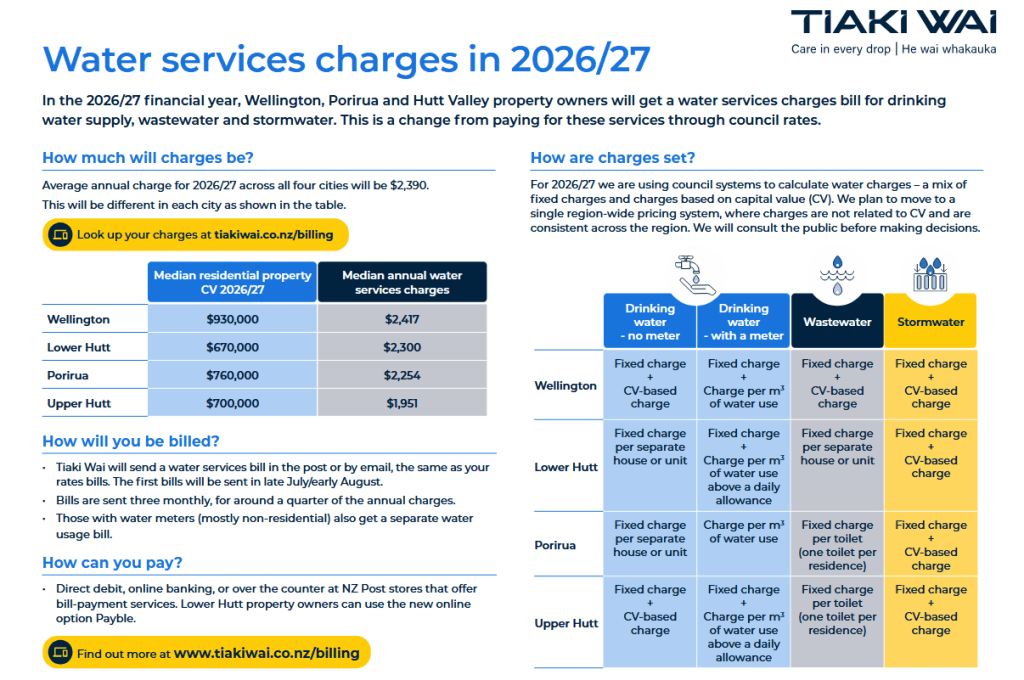
The Water Services Strategy 2026/27 released today shows that the average increase in charges across all four cities will be about $5.60 a week above what people have been paying through their rates. This is lower than initially projected.
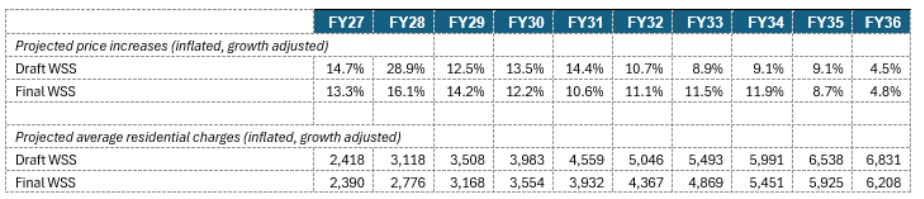
The average water services bill for 2026/27 across all four cities will be $2,390 – a 13.3% increase on the $2,100 currently paid through rates. This is lower than the 14.7 percent increase projected in the draft strategy in March. Future increases will also be less steep than projected.
“We heard strong concern from the community about the projected charges and reviewed our budget and investment plans to adjust the balance.
“We know another $5.60 a week will still be hard for those on fixed incomes. We also know that awareness and understanding of the problems we are facing increases with every sewage overflow or water leak.
“It’s becoming increasingly visible just how far we have fallen behind and how much it will cost us all to catch up and keep up with maintenance and upgrades.
“We know we must get on with the job of fixing long-standing, region-wide issues at a pace the community can support,”
Tiaki Wai will take on responsibility for over 6,800 km of pipes, more than 20% of which are in poor or very poor condition. Tiaki Wai will also take on responsibility for 140 drinking water storage reservoirs, four drinking water treatment plants, four wastewater plants and 354 pump stations.
“Many of these assets are aging and at risk of failing because of decades of underinvestment.
“We estimate it will take around $25 billion investment over the next 30 years to deliver the safe, reliable water supply and clean harbours and beaches our community expects.
“Every dollar counts. We are taking a hard look at how we can improve the way we manage investment and operations to drive down the cost of delivering improved infrastructure. Where significant decisions and investments were set before our establishment, we are testing them and making changes where justified.
“We know we need to demonstrate to our customers, partners, and stakeholders that we are responsible financial and asset managers. We also welcome independent Commerce Commission scrutiny to give communities and customers confidence in how we are operating,” says Mr Peet.
Background
In the current financial year (2025/26) the average residential water charges paid through rates across the four cities is $2,100.
The confirmed charges in the final Water Services Strategy for 2026/27 is an average across the four cities of $2,390. This is an increase of 13.3 % or about $5.60 a week.
The exact amount will vary from city to city and property to property, in the same way rates vary.
Future forecasts
The 2027/28 increase is projected to be 16.1 %, considerably lower than the 28.9 % projected in the draft Strategy.
The projected water services charges in a decade (2035/36) are approximately 10 % less than projected in the draft Strategy.
It is important to note that these figures are estimates and may change, as Tiaki Wai develops better information to inform investment plans.
Partners Committee provisional estimates
The final figures are a few dollars different to the provisional estimates presented to the Partners’ Committee on 29 May. This is due to further modelling using councils’ updated data, taking into account growth in the rating base, changes in property classifications, relative movements in residential and commercial property values, and the mix of fixed, capital value-based and volumetric charges.
A “thank you” to Tiaki Wai for sending this article to The Upper Hutt Connection.
16/06/26

