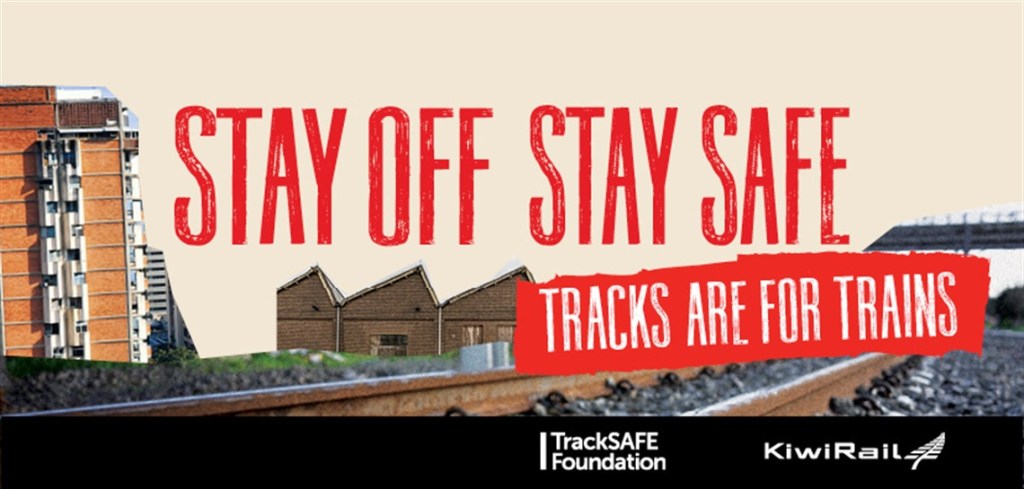
Rail Safety Week (11–18 August 2025) is an annual, nationwide campaign coordinated by TrackSAFE NZ and KiwiRail, supported by numerous organisations. The campaign aims to raise public awareness around rail safety and encourage safe behaviours near the rail network. This is an example of how road safety coordinators are collaborating at a national and regional level utilising shared campaign assets.
This year’s campaign continues to emphasise that:
- The only safe crossing is at a designated railway level crossing: These crossings are specifically designed to ensure the safety of pedestrians, cyclists, and vehicles. Before crossing, always look both ways to ensure no trains are approaching. Never assume it’s safe to cross just because a train is not in sight—trains can appear suddenly, and travel faster than you expect.
- The rail corridor is not a public walkway: The rail corridor is not meant for casual use. It’s a highly dangerous environment, with moving trains that can travel at high speeds. The area, which typically extends five meters on either side of the tracks, as well as railway bridges, tunnels, and yards, is off-limits to the public.
- The dangers are real: Since 2012, 185 lives have been lost in the rail corridor in New Zealand. Last year alone, KiwiRail recorded 642 trespassing incidents, with approximately 60 near misses involving pedestrians. These numbers highlight the continuing, serious risks posed by unauthorized access to the rail network.
- Trespassing is illegal and risky: Walking on or alongside railway tracks, or entering railway yards, bridges, or tunnels is illegal under the Railways Act 2005. Trespassing in the rail corridor is not only dangerous, but you can also be prosecuted. This law exists to protect lives and prevent avoidable injuries and fatalities.
- A widespread issue: Recent research commissioned by TrackSAFE shows that almost half of surveyed individuals admitted to walking on or across railway tracks. Despite the risks, trespassing remains a persistent issue in New Zealand and around the world, making awareness and education critical in changing behaviour.
- The impact on locomotive engineers (train drivers) and railway staff: Locomotive engineers (train drivers) and railway staff who witness or are affected by these incidents sometimes face long-term emotional trauma. Witnesses and first responders can also be profoundly affected. Preventing harm means protecting the wellbeing of all these people too.
Rail safety week is included in UHCC road safety promotion to support safer school journeys. The week is a time to draw attention to the risks around tracks, and the roles we all play to stay safe.
Every year, the campaign highlights the serious consequences of trespassing or unsafe behaviour around railway tracks. Since 2012, 184 people have died in the rail corridor, with hundreds more narrowly avoiding tragedy. In 2024 alone, KiwiRail reported 550 trespass incidents, including 60 pedestrian near misses.
Upper Hutt has three rail crossings that rank among the top 30 highest-risk sites in the country. These are the Stream Grove pedestrian crossing, and both the right-hand and left-hand pedestrian crossings on Whitemans Road. In 2024, a member of the public raised safety concerns with KiwiRail about pedestrians crossing the tracks at Ward Street while the barriers were down.
There are 5 schools that are close to level crossings and multiple college students who travel by train to schools in Lower Hutt / Wellington, students living in Pinehaven & Silverstream also cross the railway line to access busses on Fergusson drive. How students learn to travel safely is strengthened when schools take their local context into account. For many schools this includes awareness of railway tracks and trains.
We encourage you to share the message and help raise awareness within your community and networks.
Source: Upper Hutt City Council
11/08/25
 The Upper Hutt Connection