This is it. My somewhere starts in Upper Hutt.
I swept softly into the exit ramp to pull over for a coffee by the riverside little knowing that this pitstop would be a new vision for my future dreams. I was bit too early for my meet-and-greet affair with a family friend in Trentham and I had coffee in my thermos. This stop by the river seemed to be the best choice.
And on this Saturday morning I met Margaret, a retired school teacher, walking the river track with her dog. As the dog, now unleashed, scampered scooting around and doing what all happy dogs do, I struck up a ‘Hi, beautiful morning ‘ with Margaret. We started talking. She’s lived here for forty years, and in that time she’s turned down more than one invitation to move “closer to the action” in Wellington. Her reasoning is disarmingly simple: “Why would I leave a place where the mountains and the river say good morning to me every day?” Her statement reminded me of my village in Nepal.
This was my re-entry into the Upper Hutt space after a long time. The first time had been in 1995. Much had changed. I liked what I was seeing of Upper Hutt and pretty soon I found myself wanting to live in Upper Hutt.
So what would stop me from moving here.
**
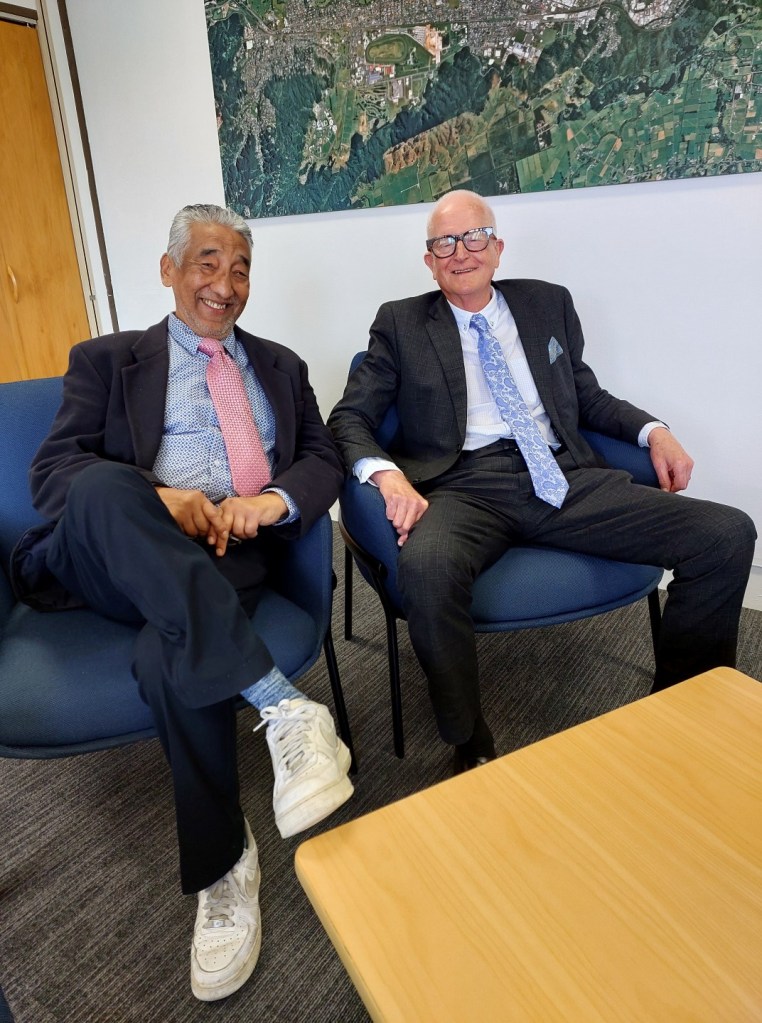
I had a few questions in my mind and I decided to bring them out with our Mayor Wayne Guppy.
Not his first rodeo
In Upper Hutt, daily life is defined by the outbound rush to Wellington, a deeper question is surfacing in my mind: how do you protect a city when its families are split by geography in possible scenarios? This was always my worry. So I asked the Mayor.
Mayor Wayne Guppy has an answer. If disaster strikes, the city will activate full civil defence mode, transforming schools into safe havens for stranded children. But the real innovation isn’t logistical—it’s educational. Children are being taught where to go, who to call, how to stay calm. Preparedness, in this case, begins with knowledge.
And in a city of many languages, translation becomes survival. Emergency instructions are being reimagined in multiple tongues, ensuring no one is left behind. It’s not just policy—it’s empathy in action.
Upper Hutt isn’t just preparing for disaster. It’s preparing to stay connected when it matters most.
And then I had this question of a possible Helipad for times when Rimutaka gets blocked because of some incident.
But Mayor Wayne Guppy doesn’t flinch. “We’ve got the racecourse,” he says. “The army camp. They’re already designated landing zones.” In other words, the infrastructure is there. The question isn’t about concrete—it’s about choreography.
Because what unfolds next is not a list of assets, but a philosophy of preparedness. Medical facilities? Accounted for. Defence Force support. On standby. Emergency protocols? Practised and refined. The city has rehearsed its isolation, like a theatre troupe preparing for a play it hopes never to perform.
But the most compelling part of the story isn’t logistical. It’s cultural. Guppy doesn’t just talk about systems—he talks about people. About Christchurch, where strangers became neighbours overnight. About the New Zealand instinct to rally, to adapt, to improvise. It’s not just resilience. It’s muscle memory.
What matters is not the pad itself, but the network of trust, coordination, and improvisation that surrounds it. In Upper Hutt, the real emergency response isn’t built on tarmac—it’s built on community. Because when the hills close in, what opens up is something deeper: a shared understanding that in moments of crisis, the most powerful infrastructure is human.
My third query : AI educated adults in the Mayor’s city
I am also a teacher of senior citizens in Wellington. I offers lessons on practical AI—translation tools, voice commands, smart searches, booklets, translations. My students are older adults, many retired, some sceptical at first. But what I’ve discovered is something quietly astonishing: they’re good at it. Not just capable, but sharp. Curious. Fast.
When Mayor Guppy is asked about similar classes in Upper Hutt he listens and nods. AI, he agrees, is not something to fear. It’s something to harness. For staffing, for operations, for efficiency. But more importantly—for inclusion. The council, he confirms, is exploring seminars to raise AI awareness across the community. Not just for the tech-savvy, but for everyone.
I offered myself a way to scale these lessons so more people—especially older adults—can learn. Because what I see in my classroom isn’t just skill. It’s transformation. Confidence. Connection.
Mayor Wayne Guppy actively agreed, assuring his support in this campaign.
This isn’t a story about machines. It’s a story about people. About how the very generation we assume might struggle with AI is, in fact, quietly mastering it. And about how a city, if it’s wise, will follow their lead.
**
Margaret’s dog ran back to her just letting her know that he was still in the playful mood and rushed back to wherever and around the path curve.
Sociologists would call Margaret’s choice a “counter‑ambition.” In a culture that prizes acceleration and visibility, she has chosen deliberation and rootedness. And she is not alone. She also mentioned that Upper Hutt is full of people like her — people who measure success not in promotions or property values, but in the neighbour who checks in after a storm, or the fact that the river is never more than a short walk away.
A “thank you” to Soren Neupane for sending this article to The Upper Hutt Connection.
30/09/25

