
Introduction
In Part 1, we traced the transformation of Te Whanganui-a-Tara and Te Awakairangi from a landscape dominated by towering forests, abundant birdlife and interconnected ecosystems to one in which more than 95 per cent of the original lowland forest was lost. The story was one of extraordinary ecological change, as forests were cleared, wetlands drained, species declined and a once continuous natural landscape became increasingly fragmented.
Yet the story of conservation in Upper Hutt does not end with loss.
The history of Te Awa Kairangi is often told as a story of what was lost. Within little more than a century, most of the great lowland forests of the Hutt Valley disappeared, wetlands were transformed, and many native species declined or vanished altogether. Yet environmental history is not only about destruction. It is also about the decisions people make in response.
As the consequences of forest clearance became increasingly apparent, a growing number of New Zealanders began to argue that remnants of the country’s natural heritage should be protected. What began as efforts to save individual forests and species gradually evolved into a broader conservation movement. In the Wellington region, the protection of places such as Kāpiti Island, Barton’s Bush, Domain Bush and the mountain forests of the Tararua and Remutaka ranges reflected a new understanding that some parts of the landscape were too valuable to lose.
Over time, conservation itself changed. The challenge was no longer simply preventing further destruction, but restoring ecological function, reconnecting fragmented habitats and creating conditions in which native species could once again thrive beyond isolated refuges. Initiatives such as Zealandia have demonstrated that ecological recovery is possible, even within highly modified landscapes.
This is the story of that transition – from protection to restoration, from saving remnants to rebuilding connections, and from preserving the past to shaping the ecological future of Te Awa Kairangi.
If Part 1 was the story of environmental transformation, Part 2 tells the story of the response. As the forests of Te Awa Kairangi disappeared and native wildlife declined, New Zealanders began asking a different question: not what could be developed, but what should still be protected. Many of the forests, reserves and ecological corridors valued in Upper Hutt today owe their existence to the answers previous generations gave to that question.
The Birth of Conservation
The forest was changed, but the story was not over.
The destruction of forests and the decline of native birds did not go unnoticed.
By the late nineteenth century, New Zealanders were becoming increasingly concerned about what was being lost. Scientists, naturalists and community leaders recognised that continued destruction would leave future generations with little understanding of the country’s original environment.
Kāpiti Island became one of New Zealand’s earliest bird sanctuaries when it was reserved in 1897. Just offshore from Wellington, it provided a refuge where native birds could survive despite the mounting pressures on the mainland.
The fight to protect Kāpiti Island inspired wider conservation efforts. Ernest “Val” Sanderson’s campaign led to the creation of the Native Bird Protection Society in 1923, now known as Forest & Bird. Sanderson argued that New Zealand had already destroyed vast areas of native forest and that the surviving remnants demanded protection for the sake of future generations.
Forest & Bird’s influence soon extended far beyond national campaigns. Through its regional branches and local advocates, the organisation became an enduring voice for the protection of forests, wetlands, rivers and wildlife throughout New Zealand. In communities such as Upper Hutt, its members helped foster public appreciation of nature and advocated for the protection of places and species that might otherwise have been overlooked or lost.
Meanwhile, extensive forests survived in the Tararua and Remutaka ranges because of Crown ownership and protected status. These mountain forests became vital refuges for species that had disappeared from the lowlands. The preservation of Barton’s Bush itself reflected a growing recognition that remnants of the original forest were worth saving. Barton’s Bush survives because Richard Barton made an unusual decision for his time. While much of the valley was being cleared in the 1840’s, he chose to retain part of the original forest so future generations could experience something of the landscape he first encountered. And because the Upper Hutt community united in 1950 to purchase and protect it as a public reserve, it remains one of the most important surviving links to the original lowland forest of the Hutt Valley. Had local communities and public authorities not intervened during the twentieth century, even this remnant would likely have been cleared. Today, it stands as one of the few places where residents can still experience something resembling the forest that once covered much of Te Awakairangi.
This achievement illustrates an important point: conservation in Upper Hutt has never been something done solely by governments or organisations. It has also been shaped by the decisions of local residents who recognised the value of protecting the natural heritage of their community.
Why Conservation Matters
Conservation is often described as protecting the past. In reality, it is about protecting the future.
The remaining forest remnants in Wellington and the Hutt Valley are not merely historical curiosities. They are reservoirs of biodiversity. They contain plants, fungi, insects, birds and ecological relationships that cannot be recreated once lost. They preserve genetic diversity that may become increasingly important as ecosystems adapt to climate change. They provide habitat for species that exist nowhere else on Earth.
Native forests also provide practical benefits.
They improve water quality, reduce erosion, store carbon, moderate temperatures and enhance human wellbeing. A city surrounded by healthy native ecosystems is more resilient, more beautiful and ultimately more sustainable than one that relies solely on engineered infrastructure.
Conservation also preserves identity.
For Upper Hutt residents, this connection is unusually tangible. A walk through Barton’s Bush, Te Mārua Bush or the foothills of the Akatarawa Forest provides a direct link to the landscape that once covered most of the valley. Few urban communities in New Zealand retain such visible reminders of their ecological past.
The forests described by Dieffenbach and known to generations of Māori before him are part of the history of the Wellington region. Protecting what remains helps maintain a connection between the present and the landscape that shaped the lives of those who came before us.
The Next Conservation Challenge
The conservation challenges facing Te Awakairangi today are different from those confronted by the first conservationists. In the nineteenth century, the issue was widespread forest clearance. In the twentieth century, it was the protection of the last surviving remnants such as Barton’s Bush and Domain Bush. In the twenty-first century, an increasingly important challenge is maintaining the ecological connections between those remaining habitats.
Ecologists recognise that individual forest remnants cannot function effectively as isolated islands. Native birds, insects, lizards and plant species depend upon connected landscapes that allow movement between habitats. Ecological corridors enable dispersal, genetic exchange, seasonal movement and recolonisation. They are essential to maintaining ecological integrity across the wider landscape.
The importance of these connections is not merely theoretical. The conservation significance of the Silverstream Spur has been recognised for decades.
The Silverstream Spur forms part of one of the remaining natural connections between the forests of Upper Hutt, Te Awa Kairangi, and the wider forest ecosystems of the Remutaka and Tararua ranges. The significance of the Spur is not a recent discovery. When the then Hutt County Council purchased the 35-hectare property from Landcorp in 1989, council officers advised that its primary purpose was reserve-related. The land was intended to complement the Silverstream Beautification Reserve, Keith George Memorial Park and the Silverstream Scenic Reserve, while also providing a buffer around the Silver Stream Railway site. The memorandum concluded that the bulk of the land was best suited to passive reserve uses.
More than three decades later, the debate is not whether the Spur possesses conservation and reserve values, but how those values should be weighed against contemporary development pressures.
For Upper Hutt, the issue is not simply the loss of vegetation on a single site. It is whether the city continues to function as a crucial ecological gateway between the lowland forests of Te Awa Kairangi and the larger forest ecosystems of the Remutaka and Tararua ranges.
The construction of a major road through the Spur would fragment that connection. While mitigation measures may reduce some impacts, habitat fragmentation inevitably introduces disturbance through clearance, noise, lighting, edge effects and barriers to wildlife movement. The history of the Hutt Valley demonstrates that ecological change often occurs incrementally, through a series of individual decisions that appear modest in isolation but collectively have profound consequences. History suggests that the consequences of such decisions are rarely measured in years or decades, but in generations.
The protection of Barton’s Bush in 1950 reflected a decision that some parts of the region’s natural heritage were too valuable to lose. The future of Silverstream Spur presents a similar question for the present generation: whether to further fragment the surviving ecological network of Te Awakairangi, or to strengthen the connections that remain.
What We Have to Gain
When Ernst Dieffenbach travelled through the Hutt Valley in the 1840s, he recorded a world of giant trees and abundant birdlife. Although that landscape cannot be recreated exactly, restoration allows us to recover some of the ecological richness that he witnessed.
For much of the twentieth century, conservation was primarily concerned with preventing further loss.
Today, it is increasingly about restoration.
Perhaps nowhere is this more apparent than at Zealandia Te Māra a Tāne in Wellington. Created within a former water supply catchment and protected by a predator-exclusion fence, Zealandia has demonstrated that ecological recovery is possible. Species that disappeared from Wellington have returned. Kākā now fly across suburbs where they had been absent for decades. Tūī and kererū are increasingly common. Native forest is regenerating.
The success of Zealandia has created what ecologists call a “halo effect”, where species spread beyond sanctuary boundaries and recolonise surrounding areas. The result is a city where biodiversity is increasing rather than declining – a rare achievement among urban centres anywhere in the world.
Upper Hutt is already seeing signs of ecological recovery. Kererū, tūī and pīwakawaka are increasingly common in many neighbourhoods, and kākā are now occasional visitors from the growing populations spreading through the wider Wellington region. These changes demonstrate that restoration is not an abstract concept. Continued restoration, predator control and habitat connectivity could further strengthen this recovery and bring more native wildlife into neighbourhoods, schools, parks and reserves.
This offers an important lesson.
While we cannot recreate the vast continuous forests seen by Dieffenbach in the 1840s, we can restore substantial parts of their ecological function. We can reconnect habitats. We can expand native forest cover. We can strengthen predator control. We can bring native birds back into places where they have long been absent.
The goal is not to return to 1840 – the goal is to create a future in which native biodiversity once again thrives alongside human communities.
What We Choose to Keep
The history of Wellington and the Hutt Valley is a story of extraordinary abundance, profound loss, and cautious hope.
Ernst Dieffenbach witnessed a landscape of giant forests and abundant birdlife. Within a few generations, most of that world had vanished beneath farms, roads, towns and cities. More than 95 per cent of the original lowland forest of Wellington and the Hutt Valley was destroyed, and many species disappeared with it. What survives today in places such as Ōtari–Wilton’s Bush, Barton’s Bush, Domain Bush, and Te Marua Bush are fragments of a once vast ecosystem.
Yet these remnants also tell another story. They remind us that conservation works. The survival of Kāpiti Island, the advocacy of Forest & Bird, the protection of remnant forests and the achievements of Zealandia demonstrate that environmental decline is not inevitable.
The history of conservation in Upper Hutt is also a history of decisions made by successive generations. Richard Barton chose to retain a portion of the original forest in the nineteenth century. The Upper Hutt community chose to purchase and protect Barton’s Bush in 1950. The Hutt County Council chose to acquire Silverstream Spur for reserve purposes in 1989. Each decision reflected a judgement about what should be preserved for the future. The choices made today will become part of that same legacy.
The forests of Wellington and the Hutt Valley will never again look exactly as they did when Dieffenbach first walked beneath their towering tōtara and kahikatea. But if we continue to value, protect and restore what remains, future generations may once again experience something that has become increasingly rare: a living landscape rich in native birdsong, native forest and the ecological inheritance of Aotearoa New Zealand.
Each generation inherits the consequences of decisions made by those who came before. The people of Upper Hutt have already demonstrated what is possible through the protection of places such as Barton’s Bush, Te Mārua Bush and Silverstream Spur. The giant forests described by Dieffenbach are gone, but the future of what remains is still ours to shape. Whether future generations inherit a richer and more connected natural environment will depend on the choices made today about reserves, restoration projects, ecological corridors and urban development. As previous generations demonstrated through the protection of Barton’s Bush, local decisions can leave a legacy that endures for decades. The question is not what was lost. The question is what we choose to keep, what we choose to restore, and what we choose to pass on.
“To keep every cog and wheel is the first precaution of intelligent tinkering.”
Aldo Leopold, Round River (1953)
Next in the Series: Part 3: A Voice for Nature, Forest & Bird and the Conservation Movement in Upper Hutt
The story of conservation in Upper Hutt is ultimately a story about people. Forests do not protect themselves. Reserves are not created by accident. The survival of places such as Barton’s Bush, Te Mārua Bush and many other areas of native habitat depended upon individuals and organisations prepared to advocate for their protection when their future was uncertain.
Among the most influential of those organisations has been Forest & Bird. Since its formation in 1923, Forest & Bird has played a pivotal role in protecting New Zealand’s forests, wildlife and natural landscapes. In Upper Hutt, local members have contributed to conservation campaigns, habitat restoration, public education and the protection of some of the region’s most significant natural areas.
Part 3 explores the history of Forest & Bird and its enduring influence on conservation in Upper Hutt. It is a story of dedicated volunteers, determined advocacy, and a belief that future generations should inherit more than fragments of the natural world. The forests and birds that survive today owe much to the efforts of those who chose to speak for them when few others would.
Barry Wards
Chair, Upper Hutt Forest & Bird
If you missed part 1 in this series, you can read the article here: Conservation in Upper Hutt: What Remains, What Endures – Part 1
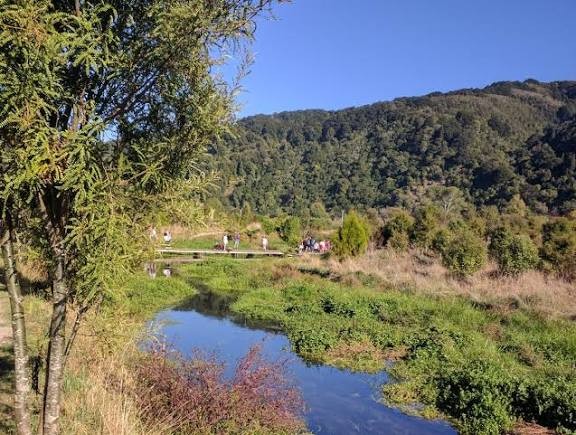
Courtesy Enviroschools Te Upoko te Ika a Māui (2021)
A “thank you” to Barry Wards for sending this article to The Upper Hutt Connection.
03/08/26

