
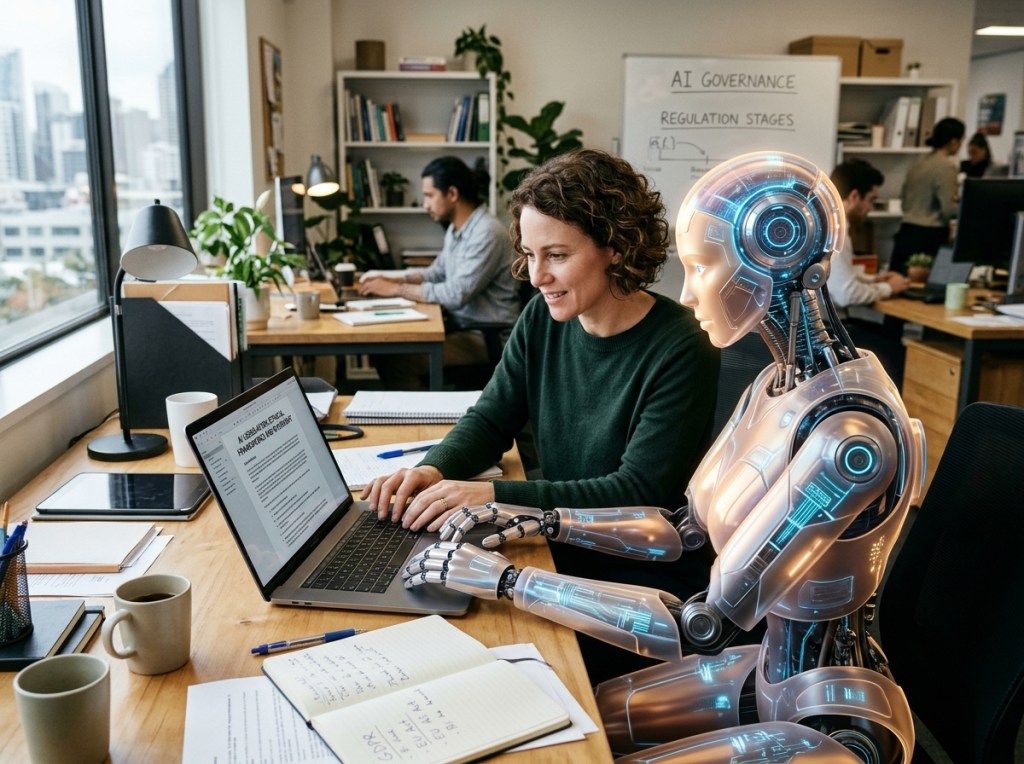
Recently I was asked why New Zealand has no AI legislation. These concerns were mirrored by respondents to a 2025 survey by Internet New Zealand identifying that 52% of people were very concerned about AI’s societal impact. I’m sure many of you would have been horrified to hear that AI could surpass human intelligence in the very near future. And that the very same companies that control AI developments are the ones warning us of the possibility. This is not science fiction; it is science fact.
Unfortunately, the genie is already out of the bottle and New Zealand is a small player in the AI development world. In fact, we are currently a receiver, not an instigator of this fast-moving technology. But please read on to find out how the government proposes to address this weakness.
Does the government have any appetite for AI legislation? The answer is no! And what about a new government? I haven’t heard a single party, big or small, propose a legislative approach. The key issue is that New Zealand is a relatively active adopter of generative AI, while development of “frontier” AI models and private investment remains concentrated overseas. We are currently users or takers of this technology. We do not have any influence in its underlying design, or infrastructure. We do not have a voice in shaping its future.
FYI, generative AI is the name for tools such as Claude or ChatGPT which about 40 percent of our people aged 15 – 64 are using. Frontier AI development is the investment in AI itself. Only a limited number of companies in the United States (US 285.9 billion invested) and China (US12.4 billion) are big enough to fund this work.
All is not lost though. International AI policy, its safe use and governance, is an increasingly important concern. The government has participated in the development or endorsement of some international AI policy statements and does have a national AI strategy (Investing with Confidence) which prioritises AI adoption, productivity and innovation, relying on existing legal frameworks and voluntary guidance. Happily, we do have power over our own computing infrastructure, data capabilities, research investment and regulatory frameworks. Our government imagines that New Zealand to be an exporter of technology resources, hence the enthusiasm for Southland’s hyperscale data centre next door to the Tiwai Point aluminium smelter. The data facility is intended to support international AI and cloud customers by exporting our computing services, using renewable electricity generation and our infrastructure. Our renewable electricity generation, cooling down the data centre computers, could benefit countries where electricity generation is reliant on thermal sources. Possibly a win for the environment?
A “thank you” to Heather Newell for sending this article to The Upper Hutt Connection.
30/10/26

