
by Soren Neupane, content blogger, tutor*
Oct 17, 2026 · soren.neupane@gmail.com
Lilla lågan brinner klar,
lyser upp där mörkret var.
What is more Swedish than standing beside a roaring bonfire at the edge of a lake, surrounded by family and friends? That has always been the tradition. The water laps gently at the shore, the flames dance against the dusk sky, and for one night the coastline becomes a gathering place. Communities come together to see off the winter and welcome the brighter days ahead. It is Valborg: a night of warmth, of heritage, and of an unmistakable Swedish spirit.
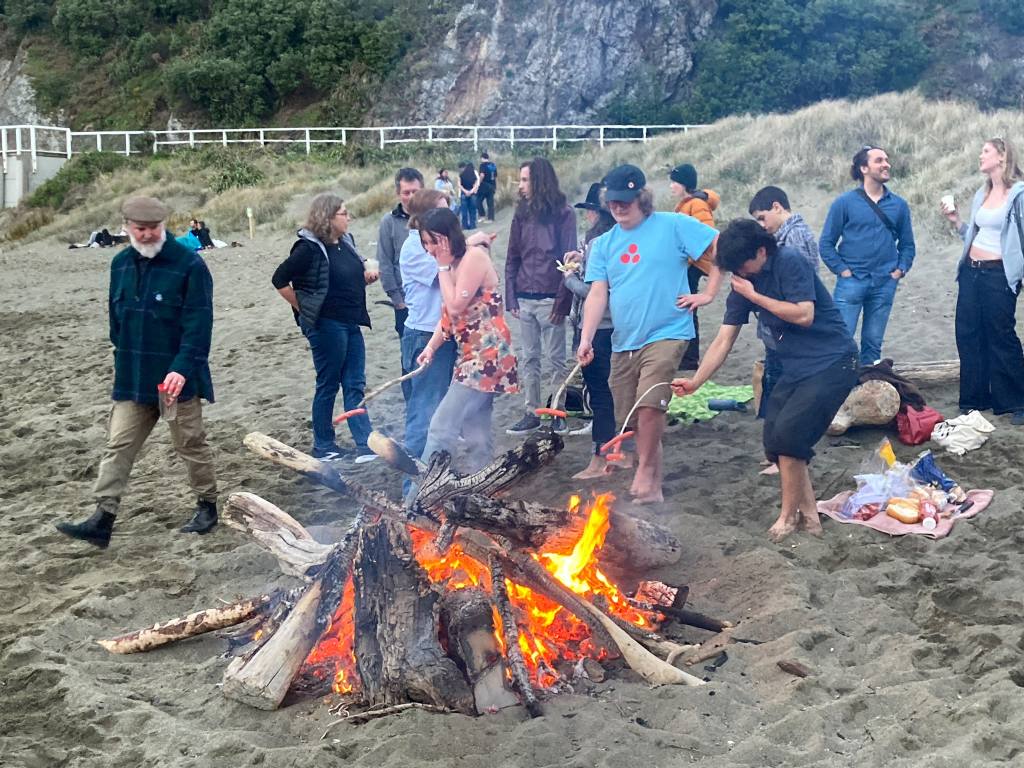
So when the Swedish community in Wellington decided to celebrate Valborg, they chose the water. Princess Beach, better known locally as Princess Bay, is a small, picturesque enclave on Wellington’s rugged south coast. It sits tucked between Houghton Bay and Te Raekaihau Point, looking out across Cook Strait. A sheltered pocket of sand, backed by coastal cliffs, it is calmer than most of that exposed coastline, which makes it a summer favourite for swimming, sunbathing and family outings.
Of course, our spring arrives in October, not April. On Saturday the 10th of October the evening turned out beautifully. No tricky winds. Smooth traffic. Enough parking. In Wellington, that is a small miracle in itself.
Where the night comes from
Walpurgisnacht, Walpurgis Night, is a blend of two things: the remembrance of a Christian saint, and much older folklore about spring and fertility. Its roots lie in Germany.
A nun named Walpurga
Saint Walpurga was an 8th-century English nun who joined the missionary movement into Germany. Her feast day falls on the 1st of May, the day in 870 AD when her relics were moved to Eichstätt and she was recognised as a saint. The night before, the 30th of April, became Walpurgis Eve. Christians prayed for her protection against illness and against witchcraft.
Older fires, older fears
The date also lines up with ancient European and Celtic spring festivals such as Beltane, which marked the halfway point between the spring equinox and the summer solstice. By the 16th and 17th centuries, the church and local folklore had tied the night to legends of witches gathering on Mount Brocken, the Blocksberg, in Germany’s Harz Mountains.
Goethe’s witches
Then came the poets. Johann Wolfgang von Goethe, in Faust, filled the Brocken with witches, bonfires and all-night revelry. He turned Walpurgisnacht into Germany’s classic Hexennacht, the Night of the Witches, and gave it the tone, the temperature and the mystery it still carries.
Skärgården: thirty thousand islands
Lakeshores, beaches and open fields all host the Valborg fires. But some of the finest are lit on the islands. Skärgården simply means “the archipelago”, and to most Swedes it means the Stockholm Archipelago: the largest in Sweden, and the second largest in the Baltic Sea. Somewhere between 24,000 and 30,000 islands, islets and skerries stretch some 80 kilometres east of Stockholm. Vaxholm, Grinda, Sandhamn, Gällnö and Rödlöga are among the best known. There are many, many more.
GULEMA and the man Friday
Some of my most unforgettable lessons in Sweden came out of choosing which of those islands to celebrate on. It took meticulous planning. Depending on where you were heading, you checked the boat traffic and made sure there would be room to moor.
Gunnar, my father-in-law, loved nothing more than taking his boat out to sea. And now he had me, his man Friday. Together we sailed around, nosing into one island after another, scouting the coast for the right place to tie up. The boat was called GULEMA, after his three children: Gunhild, Lena and Magnus.
All winter long we had been down in the boatshed, deep in the hull and its intricate compartments, getting her ready for the ice to break. Gunnar was a hard taskmaster. He was also a fair one: he made sure his man Friday got his share of schnapps when the job was done.
The teenagers’ apprentice
Gunnar wanted to teach me everything he knew, and he knew a great deal. I, on the other hand, knew nothing about boats, or about the manners and protocols of the sea. Across the water we could hear the neighbouring islands: people singing, talking, getting the bonfires ready for a night that would run long.
Around me, everyone was a qualified teacher. The family knew when to switch on the anchor light. They knew about holding ground, the seabed that keeps an anchor fast so you sleep in peace. They knew swing room, the circle a boat sweeps around its anchor when the wind or tide turns, and how to read it off the chart.
The strictest teachers of all were my nieces, Ann-Sophie and Marie. In their early teens, they had been on boats since they were born, and they seemed to know everything. Every few minutes they had a fresh lesson for me in safe and proper boating. If Gunhild had not come to my rescue, I would be an expert pirate by now.
“Take it easy on Sali,” she would tell them, Sali being her name for me, and Gunnar too, as they all rushed about mooring the boat, planning the anchor watch to keep an eye on our position and the weather through the night, and so on, and so on.
Labour-intensive joy
The Valborgs we celebrated on those islands were the most memorable of all, and the most fun. Did I mention they were labour-intensive? Luckily we had Gunnar, who planned the logistics, the navigation, and the hundred small details that can make or break a trip like that. His winter toil in the boatshed paid off, with my wee bit of help.
“Vet du vad… faktiskt är du klok,” he would say, with a grin. Roughly: you’re not as daft as you look. Ha!
Songs to sing the winter out
In Sweden, poetry does not stay on the page. It walks out to the bonfire and gets sung. Two poems in particular are inseparable from this night, though there are many, many more.
“Vintern rasat ut”
The formal title is “Längtan till landet”, Yearning for the Countryside, but everyone knows it by its first line. Herman Sätherberg wrote it in 1838 and Otto Lindblad set it to music. It is arguably Sweden’s most famous spring anthem, and choirs across the country sing it as the fires roar to life:
Vintern rasat ut bland våra fjällar, Drivans blommor smälta ner och dö. Himlen ler i vårens ljusa kvällar, Solen kysser liv i skog och sjö.
Winter has raged its last among our mountains, The flowers of the snowdrift melt away and die. The sky smiles in the bright evenings of spring, The sun kisses life into forest and lake.
“Sköna maj, välkommen”
The second comes from Johan Ludvig Runeberg, Finland’s Swedish-language national poet. It welcomes May as renewal itself, the moment winter’s gloom finally lifts:
Sköna maj, välkommen till vår bygd igen! Sköna maj, välkommen, våra lekars vän! Sorgen flyr för våren, glädje ler ur tåren…
Gorgeous May, welcome to our land once again! Gorgeous May, welcome, friend of all our games! Sorrow flees before the spring, joy smiles through tears…
A threshold in Swedish writing
Valborgsmässoafton is a sharp threshold. In a single night, winter’s cold gives way to the heat of the fire, and the turning of the season mirrors deeper turnings in people. Swedish writers have always understood this.
Strindberg and Söderberg
August Strindberg’s The Red Room (Röda rummet, 1879) uses a Stockholm spring, thaw and new light, as the backdrop for the chaotic, shifting lives of its young bohemians. The season changes; so do they.
Hjalmar Söderberg, master of melancholy, beautiful prose about Stockholm, does something quieter in Martin Birck’s Youth (Martin Bircks ungdom, 1901). A young man watches his city come alive in the spring twilight and feels a restlessness he cannot name. Anyone who has stood by a Valborg fire as the white student caps start to sing will recognise it.
From the classics to the crime shelf
The tradition runs right through to Sweden’s modern bestsellers. Henning Mankell’s Wallander novels and Stieg Larsson’s The Girl with the Dragon Tattoo are steeped in Swedish seasons, communities and customs. That is part of why they have travelled the world. They let readers into the life of a place in a way you simply will not find on a flight, a train ride or a tour bus.
Back on Princess Bay
Which brings me home to Wellington. A bonfire on the south coast, Cook Strait instead of the Baltic, October instead of April. The same songs, the same warmth, the same sense of a door swinging open onto brighter days. Gunnar would have approved. He might even have said I was not too dumb.
* This article was prepared with limited AI assistance for editing and research support. Final content and opinions are those of the author.
A “thank you” to Soren Neupane for sending this article to The Upper Hutt Connection.
17/10/26

